Click or tap to read Part 1 and Part 2 of this three-part series.
Richard Dawkins displays little knowledge of Christian theology. However, he is spot-on when he summarizes, “Pantheism is sexed-up atheism. Deism is watered-down theism.”
It’s interesting that the pioneers of early modern science were orthodox Christians who were especially allergic to occult forces within nature itself. God created the world out of nothing, but it is in its physical constitution—atoms moving freely in space, colliding to form particular things. God created and governs it all, just as he redeemed it in Christ, but the laws of nature are not grounded in the Bible but rather in the book of nature. Greeks and Romans confused God with nature. So did Renaissance humanists.
The soil for the Scientific Revolution was prepared mostly by natural philosophers and experimental scientists from the churches of the Reformation. This preponderance is documented so widely that I need not defend it here. And the most pantheistic of Radical Enlightenment thinkers, Benedict Spinoza, was condemnatory of experimental science as relying too much on bodily senses instead of the “clear and distinct ideas” in the mind. In other words, Spinoza wanted to turn science into metaphysics. The best friend of science is Christian theology, but not if scientists pretend that they are qualified philosophers and theologians pretend that they are experts in physics.
It’s amazing today how many scientists and engineers in the AI space revert to ideas that go back to the esoteric lore of early western civilization: Hermes Trismegistus, Pythagoras, Plato, the Gnostics, and Descartes. These figures play important roles in the origin of modernity, and I have done my best to trace their influence in my series on the Divine Self.
I explored in previous essays the central themes in transhumanism, a movement that has attracted significant interest from tech pioneers. Transhumanism is far from secular; its main tenets are as theological as Christian doctrines. They just happen to be the exact opposite dogmas. In fact, it makes a pact with the devil by heeding the original heresy, “You shall be as gods” (Gen 3:5).
But, in this concluding piece, I don’t want to critique pagan and transhumanist ideologies as much as extol Christian eschatology over the Gnostic eschatology of transhumanism—that Christ came, that his Spirit is making us like him, and that one day we will behold him “in our flesh.”
It Happened: The Myth Became Fact
Miracles and magic are frequently lumped together in the modern imagination. Both are perceived as superstitions challenged by science. Actually, in terms of metaphysical presuppositions, it is magic and naturalistic science that bear a closer affinity. Both perceive the world as a closed system in which the mysterious is rationalized, explained, criticized, and brought under human control. Both posit that there are recipes, procedures, and techniques that yield predictable outcomes in all times and places. The fact that magic failed to deliver and science has does not diminish this shared metaphysical outlook.
However, miracles and magic inhabit incommensurable worlds. The former are divine interventions in history. Exceptional by definition, they transcend the ordinary nexus of natural causes and effects. Magic is the product of what can be called natural supernaturalism. In a sense, everything is supernatural because nature itself is invested with divine forces. As I argued in Magician and Mechanic [affiliate link], it was Christian objections to a “Semi-Divine Nature” that opened up space for a study of nature on its own terms. Christianity is simultaneously more naturalistic and supernaturalistic than a magical worldview. God is involved in every aspect of his creation, whether through ordinary providence, working through the laws he has set in place, or by operations that are above these natural limits. God does not perform miracles in order to correct nature as such but in order to change the course of sinful human history toward the advent of Christ.
What could be more “magical” than creation ex nihilo and God becoming human to restore humanity to a condition beyond anything it has ever known? What could affirm the sacred more than the inbreaking of this age to come into the present evil age through preaching and sacrament? In the Christian view, transcendence cannot be reduced to immanence because God remains transcendent even in his immanence. Nature, history, and the self are not semi-divine forces but beautiful natural effects of creation, providence and redemption by a transcendent God “made flesh." As C. S. Lewis argued in his brilliant essay, “The Myth Became Fact,” all of the aspirations for a Messiah lie deep within the human psyche. But all calls to “re-enchantment” are really rallying cries to recover a pre-Christian, mythical, and science-fiction type of outlook.
For Kant and Nietzsche as much as for their contemporary heirs, the fly in the ointment is history. They did not really believe that contingent history could be the basis for normative facts or values. But they never disproved any of the Christian claims.
Christians believe that the conception of the Word was miraculous, but the circumstances of his birth were ordinary: “In those days a decree went out from Caesar Augustus that all the world should be registered. This was the first registration when Quirinius was governor of Syria” (Luke 2:1–2). Roman historians of the first century confirm that Augustus replaced the Jewish governor with his childhood tutor, Quirinius, who consolidated Judea and Samaria into a manageable Roman province. In the year 6 or 7, he executed the emperor’s decree for a census.
The miracles do not float above history, happening everywhere and always. Rather, they are pegged to specific locales that the first readers of the Gospels knew well. Jesus healed particular people at a particular place and time. For example, John 5:1–13 describes an event that took place “in Jerusalem by the Sheep Gate a pool, in Aramaic called Bethesda, which has five roofed colonnades.” Similar details are given in John 9:1–7 when Jesus heals the blind man with spit and mud, telling him to wash in the Pool of Siloam. Critics long alleged that neither site actually existed, but the former was discovered in nineteenth-century excavations and the latter in 2005.
There are professing Christians today, as in the first century, who preach Jesus as a source of meaning, peace, and direction in this life: Even if he were not raised, haven’t you lived a happier, healthier, and more fulfilling life? But that is not the sort of thing that Christianity is, says the Apostle to the Gentiles: “And if Christ has not been raised, your faith is futile and you are still in your sins. Then those also who have fallen asleep in Christ have perished. If in Christ we have hope in this life only, we are of all people most to be pitied” (1 Cor. 15:17–19). Call it all a hoax, but it isn’t a myth. That is simply not the nature of the claim.
Jewish historian Josephus (37–100 AD) is widely appealed to as a major source for understanding his people’s history in the first century. Most of his references to Jesus appear in Book 18 of his Antiquities of the Jews. He refers to John the Baptist (Book 18) and the life of Jesus, including his death for blasphemy, and the execution of James (Book 20). Though some scholars insist that it is a Christian interpolation, Josephus’ statement that Jesus was surely the Messiah exists in all the manuscripts of the Antiquities.
Drawing on earlier Jewish polemics, the Jewish Talmud was a product of the third and fourth centuries, a reaction against the Four Gospels. Jesus (Yeshua) was the son of Mary (Miriam) but her husband Joseph was not the natural father. Thus, the idea was invented that she had sex with a Roman soldier, Panthera. This may be based on earlier Jewish testimonies that Jesus was the son of Mary the virgin (parthenos). The second-century Platonist Celsus picked up this idea that Jesus was the son of Panthera. Significant here is the broad recognition that some explanation has to be made of Jesus’ paternity.
The Talmud refers to Jesus (Yeshua), who led Israel astray by his magic and idolatry, which again confirms that he was performing miracles and calling attention to himself as the Son of God. He gathered disciples who healed in his name. And the most consistent testimony is that he was hanged on the charge not only of sorcery (miracles) but of blasphemy (claiming to be equal with God). A host of curses are associated with Jesus in the Talmud. There is a prayer that a father may never produce a son like him.
The Emperor Claudius issued the so-called “Nazareth Inscription,” an edict in the first half of the first century: “You are absolutely not to allow anyone to move [those who have been entombed]. But if [someone does], I wish that [violator] to suffer capital punishment under the title of tomb-breaker.” What commotion was sufficient to attract the attention of the world’s most powerful leader, that he would specifically target the stealing of bodies from tombs?
So, Jewish believers in Christ and their critics, Jewish and Roman, recognized that something happened. It happened in history, not mythology, which could be challenged only by alternative historical explanations, however implausible.
Each of the arguments above can be disputed. But that is the point: They are at least truth claims. They are not subjective expressions of wish-fulfillment, effusions of sentimental piety, or myths that make a higher philosophical point. The resurrection is the point and Christians announce to the world that it is a certain event in history with cosmic implications.
As I have observed, transhumanists and many others in the AI space are drawn to pantheism, not atheism. Accordingly, God is identified with nature. The cosmic All is pure mind, like a supercomputer, simulating a game that we call reality. Christianity, in contrast, is based in reality. There are lots of other reasons I am a Christian, but the main one is that it is true. Jesus is risen indeed and we have to take our coordinates for meaning from him. He is the mediator of both creation and redemption (Col. 1:15–20).
The Christian Hope: Deification
Like the serpent in Genesis, transhumanists offer an alternative to Christian deification. Instead of being made like God as much as possible for a creature, transhumanists want to become gods through their own technological works.
The apostle Peter celebrated God’s “precious and very great promises, so that through them you may become partakers of the divine nature, having escaped from the corruption that is in the world because of sinful desire” (2 Pet. 1:4). What does it mean to be a partaker of the divine nature?
Deification was not yet anything like a locus in the system of the second-century theologian. Yet for Irenaeus and his heirs, everything in deification turns on the activity of the three divine persons in the economy rather than on the believer’s ascent to God. We do not rise up, as quasi-divine spirits returning to the One; rather, the Spirit lifts us up into the eschatological life of Jesus Christ. Irenaeus says that our glorification is not “a casting away of the flesh, but the imparting of the Spirit.”
It is precisely the gifts of consummated grace mentioned above that are identified in Reformed treatments of glorification, although the older theologians were not wary of using the term deification. While it would be going too far to suggest that deification is a major topic in Calvin, union with Christ certainly is and to the extent that deification is the consummation of this union, it is indeed a crucial part of his thinking.
Reformed theology in general and Calvin in particular shared Luther’s emphasis on the downward descent of God in the flesh. “All who, leaving Christ, attempt to rise to heaven after the manner of the giants, are destitute,” Calvin warns. “God does not command us to ascend into heaven,” he says, “but, because of our weakness, he descends to us.”
And yet, focusing merely on the descent was bound to limit—and did limit—the eschatological and pneumatological significance of Christ’s ascension for us. To Luther’s emphasis on the downward descent of Christ to us Calvin adds the equally Pauline emphasis also on the Spirit’s work of seating us with Christ in heavenly places.
As Philip Walker Butin explains concerning Calvin’s view,
There is ‘a manner of descent by which he lifts us up to himself.’ Not only does Christ (in the Spirit) condescend to manifest himself to believers by means of visible, tangible, created elements; at the same time by the Spirit, the worshiping church is drawn into the heavenly worship of the Father though the mediation of the ascended Christ, who is seated with the Father in the heavenlies. For Calvin, this accentuates, rather than diminishes, the true humanity of Christ.
It is this double movement—the descent of the Son in our humanity and the Spirit’s raising us up with Christ eschatologically—that gives Calvin’s doctrine of union with Christ a distinctively Irenaean flavor.
It is not our ascent to a spiritual realm by imitating Christ, but Christ’s exaltation and the Holy Spirit’s act of uniting us to him that is saving. Christ, by his Spirit, “lifts us up to himself.” The Father has “raised us up with him and seated us with him in the heavenly places in Christ Jesus” (Eph 2:6). In Colossians 3:1, Calvin writes, “Ascension follows resurrection: hence if we are members of Christ we must ascend into Heaven, because He, on being raised up from the dead was received up into Heaven that He might draw us with Him.” Calvin quotes Irenaeus (AH 5.2.3): “by nature we are mortal, and God alone immortal.” Jesus Christ is no longer part of this present age, but by his Spirit he brings us into his reign over sin and death and into communion with the Father, so that we truly partake of the powers of the age to come.
Some of the most obvious references made by Calvin to deification are taken from his commentaries. Expounding 2 Peter 1:4, he writes, “...that God, then, should make himself ours, so that all his things should in a manner become our things … The end of the gospel is, to render us eventually conformable to God, and, if we may so speak, to deify us." He explains:
But the word nature is not here essence but quality… There are also at this day fanatics who imagine that we thus pass over into the nature of God, so that his swallows up our nature. Thus they explain what Paul says, that God will be all in all (1 Corinthians 15:28) and in the same sense they take this passage. But such a delirium as this never entered the minds of the holy Apostles; they only intended to say that when divested of all the vices of the flesh, we shall be partakers of divine and blessed immortality and glory, so as to be as it were one with God as far as our capacities will allow… But we, disregarding empty speculations, ought to be satisfied with this one thing—that the image of God in holiness and righteousness is restored to us for this end, that we may at length be partakers of eternal life and glory as far as it will be necessary for our complete felicity.
There are several important qualifications that Calvin offers that were also made by the church fathers, particularly in the East: union not with God’s essence but by his gracious energies and participation in immortality and glory, as well as true “holiness and righteousness…as far as our capacities will allow.” Calvin’s explanation is virtually identical to that of John of Damascus, who teaches, “For these words do not mean any change in nature, but rather the economic union." This is true even in the paradigmatic case of our Lord. “Forever after the union, both the natures abode unconfused and their properties unimpaired. But the flesh of the Lord received the riches of the divine energies through the purest union with the Word.” Consequently, believers will be “deified in the way of participation in the divine glory and not in that of a change into the divine being.”
In praise of God for the mystery of Holy Communion, Calvin writes, “What is the goal of our adoption which we attain through him if it is not, as Peter declares, finally to be partakers of the divine nature (2 Pet. 1:4)?” We will be gods, not through our efforts, but by grace because of our union with Christ the God-Man.
Calvin’s thinking on this point is influenced by the second-century church father and anti-Gnostic polemicist, Irenaeus. For Irenaeus, the believer’s ascent with Christ is a Trinitarian “symphony of salvation.” Irenaeus says that we “ascend through the Spirit to the Son, and through the Son to the Father” (AH 5.36.2) and Calvin writes, “Christ, for this reason, is said to send the Spirit from his Father (John 16:7) to raise us, by degrees, up to the Father.”
Like Irenaeus, Calvin observes that Christ is Son by nature; we are sons by adoption. The reformer explains, “The designation of Son belongs truly and naturally to Christ alone: but yet he was declared to be the Son of God in our flesh, that the favor of Him, whom he alone has a right to call Father, may be also obtained for us.”
Thus there is no assimilation of the believer into Christ, as Origen’s version of deification implies. The goal of our salvation is an intimate relationship and free access to the Father through the Son and by the Spirit. “For [Christ] was not appointed to be our guide,” says Calvin, “merely to raise us to the sphere of the moon or of the sun, but to make us one with God the Father.”
Where Latin theology conceived of union as a goal, through the infusion of a gracious substance, Calvin saw union with Christ as the beginning, middle, and end. “Hence, too, we infer that we are one with the Son of God; not because he conveys his substance to us, but because, by the power of his Spirit, he imparts to us his life and all the blessings which he has received from the Father.”
For this intimate and eschatological conception of union, Calvin was fond of the organic image of ingrafting. The gospel “testifies that we shall be partakers of the divine nature, for when we shall see God face to face, we shall be like him (II Pet. 1:4; I John 3:2).” Elsewhere he adds,
This is the wonderful exchange which, out of his measureless benevolence, he has made with us; that, by his descent to earth, he has prepared an ascent to heaven for us; that, by taking on our mortality, he has conferred his immortality upon us; that, accepting our weakness, he has strengthened us by his power; that, receiving our poverty unto himself, he has transferred his wealth to us; that, taking the weight of our iniquity upon himself (which oppressed us), he has clothed us with his righteousness.
Calvin’s phrase here, “wonderful exchange” is found in Irenaeus; in fact, Balthasar suggests that “exchange” was the “fundamental approach” of the church fathers’ view of deification. Calvin calls deification “that ‘than which nothing more outstanding can be imagined’ [quo nihil praestantius cogitari potest]. The goal of humanity from the beginning was to arrive finally at immortality. Being God’s image is “participation in God” in Christ as the mediator of creation, Calvin says, but justification and re-creation in Christ by grace is a joy beyond words.
In the trajectory of the ancient Christian philosopher Origen, deification is a matter of becoming less human: more like henōsis, union as assimilation of the true spiritual self to God than a covenantal union of distinct persons in an intimate and mystical koinōnia through the mediation of the one who is both God and human.
For Irenaeus, however, Farrow notes, “deification is hominization through the commending of the whole man, body and soul, to the Spirit, as the eternal inheritance of God in Jesus Christ. The ascension of Jesus Christ is not the return of God to God. It is the ascension of the God-man to his rightful place, the place of glory that Adam and Eve never knew, but are yet destined to know…We will be deified by the Spirit, knowing God by way of God.” As Irenaeus himself puts it, “The glory of God is a human fully alive.”
The “fanatics” imagine that at death “we shall revert back to our original state” to be absorbed into deity, Calvin observes. However, Jesus’ deity did not overwhelm or assimilate his humanity. Analogously, the essence of the physical elements of bread and wine are not annihilated in the Eucharist; it is precisely in their remaining creaturely substances that they are a means of grace. As Calvin puts it, “…salvation and life are to be sought from the flesh of Christ in which he sanctified himself, and in which he consecrates Baptism and the Supper.”
Our conformity to Christ, then, is not a matter of becoming less creaturely, but more truly human.
Furthermore, to be united to Christ is to be in communion with his ecclesial body. It is not the ascent of the lonely soul, like Plotinus’s “flight of the alone to the Alone.” As the true humanizing of the elect, recapitulation is also the true socializing of the anti-covenantal “disengaged self.” This participating in the divine nature by grace is “produced in our souls by an emanation of power, virtue, and efficiency from [Christ],” writes John Owen. Yet, he adds, this is not of believers only as individuals, but of the whole church in its likeness to Christ.
If this consummation of our union with Christ is less than absorption into deity, as Calvin argues especially against Osiander, it is more than mere “fellowship,” as he argues against Erasmus and Zwingli. It is telling that he rejects Erasmus’ translation of koinōnia as fellowship and that the church consequently should be viewed as a mere societas rather than a communio. Calvin adds that “mystical union” is “accorded by us the highest degree of importance”; we do not receive his gifts without being united to Christ himself. As Bavinck notes, “Just as surely as the re-creation took place objectively in Christ, so surely it must also be carried out subjectively by the Holy Spirit in the church…The church is an organism, not an aggregate; the whole, in its case, precedes the parts.”
Reflecting its “Irenaean” impulses, Reformed ecclesiology can therefore affirm Augustine’s totus Christus—that is, referring to the Head and members as “the whole Christ”—without assimilating the natural body of the ascended Christ to the church.
This is the highest honour of the Church, that, until He is united to us, the Son of God reckons himself in some measure imperfect. What consolation is it for us to learn, that, not until we are along with him, does he possess all his parts, or wish to be regarded as complete! Hence, in the First Epistle to the Corinthians, when the apostle discusses largely the metaphor of a human body, he includes under the single name of Christ the whole Church.
In fact, he adds, “They shall constitute one person.”
However, Calvin’s version of totus Christus is eschatological rather than anthropological. The relation of Head and members is not that of pneuma and sōma, but of a husband and wife, Vine and branches, first-fruits and harvest.
Bavinck nicely summarizes the Reformed consensus:
As the church does not exist apart from Christ, so Christ does not exist without the church. He is ‘the head over all things’ (Eph. 1:22; Col. 1:18), and the church is the body formed from him and from him receives its growth (Eph. 4:16; Col. 2:19), thus growing to maturity ‘to the measure of the full stature of Christ” (Eph. 4:13)... Together with him it can be called the one Christ (1 Cor. 12:12). It is to perfect the church that he is exalted to the Father’s right hand.
It is significant that, according to the apostle Paul, the revelation of the church in these last days is part of Christ’s boast in his triumph over the powers and principalities. Through the proclamation of “the unsearchable riches of Christ,” he says, “the mystery hidden for ages” is revealed, “so that through the church the manifold wisdom of God might now be made known to the rulers and authorities in the heavenly places” (Eph 3:8–10).
The Final Joy: Beatific Vision
The qualifications that Calvin endorses here are not only present in the mainstream of Christian orthodoxy, East and West, but are frequently repeated by Reformed theologians. The point is not to bring Christ down before his return in glory, Ursinus observes, but to be united to the ascended Christ by the Spirit through the gospel. Christ is still present with us, not only by his divinity, but “by union with his human nature; for it is the same Holy Spirit who is in us and him, who unites us to him…Our glorification results from Christ’s ascension into heaven.”
Francis Turretin is representative of this consensus when he writes, “Furthermore, we will—in body as well as soul “cleave so unchangeably to God that we shall in a measure be transformed into him by a participation of the divine nature. In this sense David says, ‘I shall be satisfied, when I awake, with thy likeness’ (Ps. 17:15). And Christ asks for believers ‘that they all may be one’ (John 17:23), viz., through love; and that the love wherewith the Father has loved him may be in them and he in them (v. 26).”
Thomas Aquinas stipulated, “When…a created intellect sees God in his essence, the divine essence becomes the intelligible form of that intellect.”
However, quoting John of Damascus, Turretin maintains that we will behold God not in his essence, but in the face of Christ. It is a matter of apprehending a goal, as in finishing a race (Phil 3:13–14). Sharing Job’s hope (Job 19:25), we will behold the invisible God with our physical eyes—“that is, of the sight of the incarnate Son of God with respect to his human nature.” Similarly, Owen explains, “The enjoyment of God by sight is commonly called the beatific vision,” but it is “the state of blessedness: which the old philosophers knew nothing of; neither do we know distinctly what they are, or what is this sight of God. Howbeit, this we know, that God in his immense essence is invisible to our corporeal eyes, and will be so to eternity; as also incomprehensible to our minds… Wherefore the blessed and blessing sight which we shall have of God will be always ‘in the face of Jesus Christ.’”
God’s essence will always remain invisible and we will always remain embodied, observes Turretin. “A faculty can be elevated above its own natural grade by supernatural grace, but not above its own species and the object analogous to it.” Turretin goes so far as to say, “There is nothing else than a certain effusion and emanation [apporroē] of the deity upon the souls of the saints, communicating to them the image of all his perfections,” but adds, “as much as they can belong to a creature.”
In fact, the Reformed orthodox interpreted the beatific vision, deification (or glorification), and the resurrection of the body as one and the same event. Again, Turretin is representative: The resurrection will cause the saints to shine in beauty forever, he says, from the uncreated energies of God’s own glory. This vision will bring “a perfect likeness of the saints to God” and “from this communion with God will arise that wonderful glory with which the saints will be endowed both as to the soul and as to the body.” Just as the Holy Spirit unites us to Christ without annihilating his substance or ours, and unites consecrated bread and wine to Christ with all of his benefits without annihilating the earthly elements, Turretin argues that this world will not be annihilated, but will share in the cosmic glories of the resurrection. Our bodies will be changed, adds Turretin, “not with a change of substance, but only in reference to qualities." Though God is immortal by nature, we will be made “immortal by grace from the beatific vision…However, that splendor will flow both from the blessed vision of God, whom we shall see face to face, and from the glorious view of Christ exalted in his kingdom; and it will be nothing else than the irradiation of God’s glory, from which the bodies will be made to shine.” In fact, Thomas Watson went so far as to say, “The dust of a believer is part of Christ’s mystic body.”
While in Aquinas, not to mention Origen, the beatific vision is attained through the soul’s ascent of mind to behold God in his essence, for Calvin and his heirs it is the resurrection-glorification of the body to behold God in the face of Christ.
Acts 3:21 tells us that Jesus must remain in heaven “until the times of restitution of all things” (apokatastasin pantōn). “Now if all things are to be restored,” reasons Turretin, “they are not therefore to be annihilated." It is God’s habit to destroy the works of darkness, not the fruit of his own labors. Michael Levering points out that Aquinas correlates eternity and time with heaven and hell. However, Turretin interprets the angel’s statement, “Time will be no more” (Rev. 10:5–6) to mean the time of this present evil age. In other words, it is an eschatological rather than an ontological antithesis: two ages, not two worlds.
We are not saved from matter, history, and this world, but rather, in all of our creaturely finitude, saved together with the rest of creation. The problem has never been metaphysical, but ethical and covenantal. Bavinck summarizes that in contrast to Neoplatonism, even in its Christianized forms, Reformed theology sees grace not as a substance but as the favor and gift of the Father, in the Son, by the Spirit. The problem is not grace versus nature, but grace versus sin. Christ’s saving work does not reconcile nature and grace, as if they were opposed, but rather reconciles sinners to God by grace. Redemption liberates nature, and our humanity specifically, to share in Christ’s exalted glory.
In short, Bavinck concludes, grace is not simply “an aid to humans in their pursuit of deification”; it is “the beginning, the middle, and the end of the entire work of salvation: it is totally devoid of human merit. Like creation and redemption, so also sanctification is a work of God. It is of him, and through him, and therefore also leads to him and serves to glorify him.” Thank God we are not gods by nature, but only made as much like God as possible for creatures to be. And the one who secures this is Jesus of Nazareth, who by his Spirit now unites us to his victorious body and soul.
Never Satisfied
Many people assume that there is an endpoint to personal existence, either in bliss or in punishment. What is the difference, really, between a materialist belief that the death of a human being is no different than that of a dog and the expectation that one’s personal existence is extinguished, like a drop of water in the ocean of being?
The biblical hope is radically different. The distinction of persons is part of our good nature, and whatever is good will be preserved and raised to inexpressible heights. Whether with respect to the incomprehensible God or his goodness in the new creation, we will never be satisfied—not from any lack, but from intoxication with the goodness, truth, and beauty of God. Even an exquisite feast reaches a climax because of our digestive limitations.
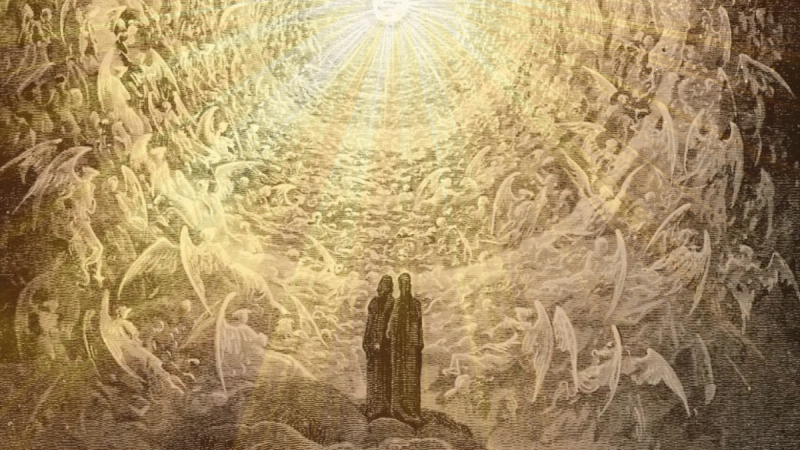
But not only will the delights of Paradise never run out; we will never reach a place of complete satiation of our hunger for more. God will always transcend us infinitely. While alluring us by his nearness, he will remain forever incomprehensible in his majesty. The eternal Other beyond being, the Triune God will always be the one in whom we live and move and have our being. This final communion with God, anchored in the union with Christ and justification is not only a better story than self-deification through technology. It is the difference between heaven and hell.
Footnotes
Richard Dawkins, The God Delusion (Boston: Houghton Mifflin, 2006), 40-41.
BackJohn Haralson Hayes and Sara R. Mandell, “The Herodian Period,” in The Jewish People in Classical Antiquity: From Alexander to Bar Kochba (Louisville: Westminster John Knox, 1998), 153-54; Erich S. Gruen, “The Expansion of the Empire under Augustus,” in The Cambridge Ancient History, Volume X: The Augustan Empire, 43 BC-AD 69 (Cambridge: Cambridge University Press, 1996), 157.
BackSee Urban C. von Wahlde, “The Puzzling Pool of Bethesda,” Biblical Archaeology Review, September-October, 2011. https://library.biblicalarchaeology.org/article/the-puzzling-pool-of-bethesda/. Retrieved September 3, 2025.
BackFlavius Josephus; translated and edited by William and Paul L. Maier, The New Complete Works of Josephus (Grand Rapids: Kregal, 1999), 284-85.
BackPeter Schafer, Jesus in the Talmud (Princeton: Princeton University Press, 2007), 18-19.
BackMark Allen Powell, Jesus as a Figure of History: How Modern History Views the Man of Galilee (Louisville: Westminster John Knox, 1998), 34.
BackSee the excellent summary of Talmudic references to Yeshua in Joseph Klausner, Jesus of Nazareth, trans. XXXX (Boston: Beacon, 1964).
BackThe translation is from Clyde E. Billington, “The Nazareth Inscription: Proof of the Resurrection?”, Artifax (Spring 2008).
BackCanlis makes this point in Calvin’s Ladder, 177, from Mary Ann Donovan, One Right Reading? A Guide to Irenaeus (Collegeville, MN: Liturgical Press, 1997), 118: Irenaeus’s approach is through description of the divine activity in the economy rather than through description of the stages of mystical ascent to God. The result in either case is union with God: Irenaeus’s concern is with the divine role in effecting this union….This principle distinguishes the Irenaean position from platonic, Gnostic, and later patristic teaching on the ascent of the soul.
BackCanlis, Calvin’s Ladder, 183-84, quoting Irenaeus, AH, 581. In the same place, Canlis adds, “Oscillating between exclusion and fusion,” Canlis observes, “Gnostic anthropology can best be seen as schizophrenic. In neither scenario can the human as human participate in God as God." However, “For Irenaeus, the secret was not ‘a casting away of the flesh, but by the imparting of the Spirit.’”
BackAs Todd Billings has shown, Calvin’s view of deification is distinguished from that of Origen and Gregory Palamas. See J. Todd Billings, “United to God through Christ: Assessing Calvin on the Question of Deification,” Harvard Theological Journal 98, no. 3 (2005): 315-34. For a more thorough treatment, see his Calvin, Participation and the Gift: The Activity of Believers in Union with Christ (New York and Oxford: Oxford University Press, 2008).
BackComm. John 8:19.
BackCalvin, XXXX.
BackPhilip Walker Butin, Revelation, Redemption and Response: Calvin’s Trinitarian Understanding of the Divine-Human Relationship (N.Y.: Oxford University Press, 1995), 118.
BackCalvin, 4.17.31 (emphasis added).
BackCalvin, Comm. Col. 3:1.
BackCalvin, “Psychopannychia,” T&T III.478.
BackCalvin, Serm. Luke 2:1-14, CO 46.966.
BackIn view of the systematic role that such statements play in Calvin’s commentaries and treatises, including the Institutes, I share Mosser’s surprise at comments such as the following from F. W. Norris: “John Calvin seems to have avoided teaching deification or not known of it” (‘Deification: Consensual and Cogent,” SJT 49/4 (1996), p. 420). Mosser writes, “Insufficient familiarity with the patristic writings is precisely why many of Calvin’s interpreters have not recognized the presence of deification in Calvin even when it has stared them in the face…One should not overstate the significance of deification’s presence in Calvin, as the Finns have done with regard to Luther.” It is a presupposition suffused throughout his writings, more than a topic. He didn’t have to defend it, after all; it wasn’t in dispute. He just assumed the idea.
BackCalvin, Comm. on 2 Peter 1:4.
BackSee Carl Mosser, “The Greatest Possible Blessing: Calvin and Deification,” SJT 55, no. 1 (2002): 36 [?] After citing Calvin (“Peter’s word ‘nature’ does not refer to God’s essence but to ‘kind’ or ‘quality’”), Mosser adds a valuable parenthetical comment: “(note the functional similarity with the Orthodox essence/energies distinction)” (54). I concur with Mosser’s point—and would underscore its importance in Calvin’s thinking.
BackJohn of Damascus, “Exposition of the Orthodox Faith” in NPNF2, 9:65-66. Compare also with Calvin’s formulation in his Commentary on Jn 6:51.
BackIbid., 9:31.
BackCO 9.351, cited in Joseph Tylenda, “The Controversy of Christ the Mediator: Calvin’s Second Reply to Stancaro,” Calvin Theological Journal 8 (1973): 148.
BackAH 4.14.2
BackJulie Canlis, Calvin’s Ladder, XX, citing Joseph Tylenda, ‘Christ the Mediator: Calvin Versus Stancaro,’ CTJ 7 (1973): 16.
BackCalvin, Inst. 2.14.5.
BackCalvin, Comm. Matt. 3:17.
BackCalvin, Comm. John 14:28.
BackCalvin, Comm. John 17:21.
BackCalvin, The Epistles of Paul the Apostle to the Romans and to the Thessalonians (trans. Ross Mackenzie [Eerdmans, 1960], 124.
BackCalvin, The Epistles of Paul the Apostle to the Romans and to the Thessalonians (trans. Ross Mackenzie [Eerdmans, 1960], 105.
BackCalvin, Inst. 4.17.2.
BackHans Urs von Balthasar, Theo-Drama: Theological Dramatic Theory. Vol 4 (trans. Graham Harrison; San Francisco: Ignatius Press, 1994), 244.
BackCarl Mosser, “No Greater Blessing,” 40, comment on 2 Pet 1:4, from CO 55.446). “…a kind of deification [quasi deificari]” (Comm. on Second Peter, 330).
BackCalvin, Inst. 2.1.1.
BackCalvin, Inst. 2.2.1.
BackDouglas Farrow, Ascension Theology, 144, 150.
BackAH 4.20.7.
BackSecond Peter, p. 330; cf. Inst. 1.15.5.
BackCalvin, “True Partaking,” T&T II.554).
BackJulie Canlis Calvin’s Ladder, 114.
BackPlotinus, translation in Andrew Louth, The Origins of the Christian Mystical Tradition from Plato to Denys (Oxford: Clarendon Paperbacks, 1983; repr. 1992), 51. Cf. Plotinus, Enneads I.6.9: “So ascending, the soul will come to Mind . . . and to the intelligible realm where Beauty dwells.”
BackI borrow this phrase from Charles Taylor, Sources of the Self: The Making of the Modern Identity (Cambridge: Harvard University Press, 1992).
BackJohn Owen, “The Person of Christ,” 1:366.
BackCite Calvin
BackCalvin, Inst. 3.11.10.
BackHerman Bavinck, Reformed Dogmatics, 3:524.
BackSee Michael Horton, Covenant and Salvation, XX-XX; cf. Julie Canlis, Calvin’s Ladder, XX-XX. I realize that the ancient fathers used methexis and koinonia interchangeably. I distinguish them more systematically here because in their original use, they do reflect different versions of participation that are exhibited in contemporary discussions.
BackJohn Calvin on Eph 1:23 in Commentaries on the Epistles of Paul to the Galatians and Ephesians, trans. William Pringle (Grand Rapids: Eerdmans, 1957), 218.
BackCalvin, Comm. Eph. 5:31.
BackHerman Bavinck, Reformed Dogmatics, 3:474.
BackZacharius Ursinus, Commentary on the Heidelberg Catechism (Trans. G. W. Williard; Phillipsburg, NJ: Presbyterian and Reformed Publishing Co., repr. of 1852 ed.), 249, 252.
BackFrancis Turretin, Institutes of Elenctic Theology, 3:611.
BackThomas Aquinas, Summa Theologica i. 12.5 (trans. Fathers of the English Dominican Province; repr. Westminster, Md: Christian Classics, 1948).
BackFrancis Turretin, Institutes of Elenctic Theology, 3:611.
BackFrancis Turretin, Institutes of Elenctic Theology, 3:610.
BackJohn Owen, “The Person of Christ,” 1:292.
BackFrancis Turretin, Institutes of Elenctic Theology, 3:611.
BackFrancis Turretin, Institutes of Elenctic Theology (ed. J. T. Dennison; trans. G. M. Giger, 1992), 3:209 (emphasis added).
BackAs the Belgic Confession concludes, “And for a gracious reward, the Lord will cause [his elect] to possess such a glory as never entered the heart of man to conceive” (Belgic Conf., Art 37). From the ascension we are assured, according to the Heidelberg Catechism, “first, that Christ is our advocate in the presence of his Father in heaven; second, that he as the head, will also take us, his members, up to himself; third, that he sends us his Spirit as an earnest, by whose power we seek those things which are above, where Christ sits at the right hand of God, and not the things on the earth” (Heidelberg Catechism, LD 18, Q. 49). When Christ returns in the flesh, the Westminster Confession adds, “The bodies of the unjust shall, by the power of Christ, be raised to dishonor: the bodies of the just, by His Spirit, unto honor; and be made conformable to His own glorious body” Westminster Confession of Faith, 32.3).
BackFrancis Turretin, Institutes of Elenctic Theology (Philadelphia: P&R, repr. 1992), 609. Only Jonathan Edwards seems to represent a significant departure from this norm on key points, affirming deification in a more Origenist or at least Neo-Platonist direction. See Michael J. McClymond and Gerald. R. McDermott, The Theology of JE (NY: Oxford University Press, 2012): “The whole body of Edwards’ metaphysical and typological reflections rested on a notion of continuity between Creator and creation” (105). Support with JE, The Works of JE, ed. Thomas A. Schafer, vol. 13, Miscellanies (YUP, 1995), 295. According to 2 Cor 3:18, the divine light “changes the nature of the soul” and “it assimilates the nature [of the soul] to the divine nature” (A Divine and Supernatural Light (Boston: S. Kneeland and T. Green, 1734), 16. McClymond compares Edwards’ view of theosis to that of Gregory Palamas (Paul Helm and Oliver Crisp, Philosophical Theologian [Aldershot, England: Ashgate, 2003], 145).
BackFrancis Turretin, Institutes of Elenctic Theology, 3:612, emphasis added.
BackFrancis Turretin, Institutes of Elenctic Theology, 3:618-19.
BackThomas Watson, A Body of Divinity Contained in Sermons upon the Westminster Assembly’s Catechism (Edinburgh: Banner of Truth Trust, repr. 1965), 309.
BackFrancis Turretin, Institutes, 3:591, 594-95. Veering too closely to the “Calvin vs. the Calvinists” thesis, Julie Canlis suggests, “Turretin is an example of a Reformed theologian who embraced Calvin’s rich themes of substitution (perhaps even outshining Calvin) but who did not incorporate Calvin’s themes of participation” ( ). It is difficult to justify this claim from Turretin’s, if anything, more expansive treatment of the beatific vision and glorification. Canlis seems to oppose the legal to the relational at this point, as does her citation of Colin Gunton: “As Gunton says of Calvin, ‘Jesus’ life and death are there not to perform some external substitution, but yet to take our place in such a way that we are truly brought to God” ( ). However, this misses the point of Calvin’s transition to Book 3. He has emphasized in Book 2 that we are redeemed once and for all, objectively, by Christ’s work outside of us. This is why he begins Book 3 by saying that if this is all to salvation, then we are not really united to Christ by the Spirit and his alien righteousness would be to no avail. It isn’t either-or, but both-and.
BackMichael Levering, Jesus and the Demise of Death: Resurrection, Afterlife, and the Fate of the Christian (Waco: Baylor University Press, 2012), 113, citing Aquinas ST I, q. 10, a. 3, ad 2.
BackFrancis Turretin, Institutes, 3:596.
BackBavinck, Reformed Dogmatics, 3:578. He adds here, “The Reformation did confess of grace that it is not only external but also internal, that it bestows not only moral but also ‘hyperphysical’ (supernatural) powers, that it is a quality, a disposition. But even though it sometimes expressed itself in the same terminology as Rome, it put a different meaning on it.”
BackBavinck, Reformed Dogmatics, 3:579.
Back