
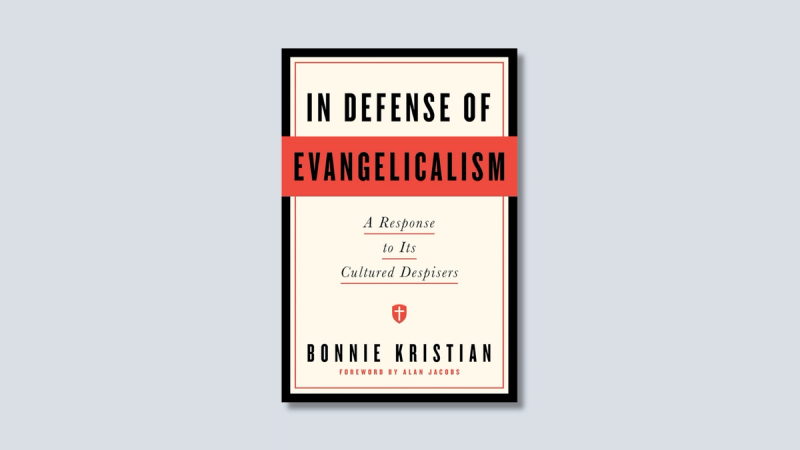
In Defense of Evangelicalism: A Response to Its Cultured Despisers
By Bonnie Kristian
Forum Books | 2026 | 224 pages (hardcover) | $16.99
I was wary when I heard how great this book was. In former times, the genre of a book like Bonnie Kristian’s In Defense of Evangelicalism was known as an “apology.” It meant a formal defense, a word to turn away attacks (the Greek roots apo “away from” and logos “word”). Being a self-proclaimed evangelical, I’ve heard more than my fair share of mainstream “apologia’s” of evangelicalism. Most of the time they were less of a defense and more of the modern use of the word: apologizing for evangelicalism.
The formula was fairly straightforward and, to be fair, effective: get a prominent, mainstream “evangelical” to write an essay or book “explaining” evangelicals to the rest of the world, like an explorer might write of a newly found people group deep in the Amazon rainforest. And in the course of the piece, he or she would critique and distance themselves from evangelicalism as much as possible. This has ramped up during the Trump years with evangelicals’ largely unwavering support for Trump, and the “cultured despisers,” as Bonnie Kristian puts it, increasingly alienating themselves from the evangelical base. Over the last ten years, the gulf between those who write about evangelicalism and those who experience it on a week by week basis has continued to widen.
This book helps to bridge that gap. If we pictorially placed this gulf up on the felt board of my evangelical youth, In Defense of Evangelicalism would be substituted for the cross as it triumphantly rests in the middle of that chasm, reconciling the two parties. Kristian is able to be this lowercase “m” mediator, for she is both an author working alongside the cultured despisers, but also an evangelical and not embarrassed about it. She is not ashamed to call us her brothers, as the author of Hebrews might have put it. Not only is she a great writer, both humorous and sincere, but she refreshingly presents a bold and straightforward defense of a people to whom she confessedly and unashamedly belongs.
As a lifelong evangelical myself, I felt, as the kids today say, seen.
If someone else thinks they have reasons to put confidence in their evangelicalism, I have more: born into First Baptist Church of Atlanta under Dr. Charles Stanley, my father a graduate of Dallas Theological Seminary, of the dispensationalists with loyalty to America and Israel; in regard to my undergrad, Liberty University; as for zeal, attender of Passion Conferences; as for righteousness based on the law of True Love Waits, faultless… mostly, maybe, well, it depends—who cares, let’s move on.
But I’m also a millennial, and the world I came of age in was scary: the rise and prominence of school shootings when I was in elementary school, the post-9/11 world order during my high school years, and all of this just to see the economy collapsing as I graduated college. The Global War on Terror began when I was 13 years old and we left Afghanistan disastrously when I was 34. For many my age, their evangelicalism couldn’t handle all the turmoil. They needed better answers.
There were certainly times I wanted to jettison it, and certainly times when I did. But it always remained there, like a habit you fall back into. Eventually, particularly as I got into full time ministry, I came back to those old habits. Penal substitutionary atonement preaches, the other less “evangelical” atonement theories just don’t. And while we might want to drop our evangelicalism like a home schooler drops her faith during freshman rush week, it tends to hang on to you longer than you expect. Many of the supposed “ex-vangelicals” haven’t left behind their evangelicalism as much as they are reacting towards something that is still a part of them.
And so, people in my shoes have felt a bit stuck. We can’t get rid of our evangelicalism, because we recognize at the core it’s just basic Christianity, and evangelicals are just basic Christians. But, we also have felt more than a bit insecure about our position in the world today, and more than a bit unsure if we can really “cut it” as evangelicals in the twenty-first century.
And this is what makes Bonnie Kristian’s book so good: she has fully integrated her evangelicalism with the rest of her life. There’s no insecurity, no embarrassment, no sense of wishing she could be accepted by her audience. It was such a relief to see someone unapologetically defend the world that I had known so well without any hint of explaining away or hiding.
The book is shaped around five common attacks on evangelicalism: their sincerity, their beliefs are evil, their hypocrisy, their pushiness with evangelism, and their desire for political control. All of these are ably and cleanly refuted. However, none of these are inherently theological attacks. The five attacks she chooses to address are actually focused on evangelicals themselves. If you pick up this book expecting a theological defense of Penal Substitutionary Atonement or Biblical Inerrancy then you will be disappointed. That’s not what this book is about.
This actually ends up being my only critique of the book: it has the wrong title. This is not “In Defense of Evangelicalism” but “In Defense of Evangelicals.” And the book is better for it by focusing on defending the people who make up evangelicalism than the “ism” itself.
In Defense resonated with me and my own spiritual autobiography. I have plenty of issues with “evangelicalism.” It is all too easily susceptible to semi-Pelagianism, it has a disdain for church structures that allow for ministry to be protected and flourish in the long term, it has a tendency to throw out old forms of ministry that it should keep and uncritically adopt new forms that it should reject. For these and many other reasons, I left the non-denominational evangelical world.
I’m sympathetic to some of the “cultured despisers” that Bonnie Kristian interacts with in the book. I can see some of their arguments and the merits of them. Kristian, however, brilliantly skirts past these arguments by pointing out that almost all of them are directed at the evangelical leaders who often represent evangelicalism, but very few of them apply to evangelicals themselves. In her chapter on whether or not evangelicals are hypocritical, she writes, “I want to distinguish between evangelical elites—famous pastors, activists, and influencers—and ordinary evangelicals. With [Tim] Alberta, I want to say there’s a difference between the ‘people who knew better’ and ‘those who did not’” (61).
She also notes that oftentimes the critics of evangelicalism found their main audience to be none other than evangelicals themselves! Kristian points out that for all the attacks Kristen du Mez levied on them in Jesus and John Wayne, du Mez herself admitted it was many evangelicals who were her book’s “biggest fans” and asking how they could improve. Kristian writes, “This reception undercuts the thesis of Jesus and John Wayne. It may not be too much to say this reception disproves the thesis, because it sounds a lot like Jesus—and not much like John Wayne. It sounds like an eagerness for self-examination, for accountability, for repentance where needed…” (49).
There’s a hunger to love their neighbors, to repent of wrongdoing, to heal what has been broken. In other words, the obvious desire to do the right thing that would lead evangelicals to buy du Mez’ book isn’t reflected in du Mez’ own critique of them.
Kristian puts her finger on the pulse of something I’ve felt for awhile but didn’t know how to express. For all the issues with evangelicalism, when it comes down to it, I cannot help but think that the people I was around were real Christians. As you read through Kristian’s defense, you get the sense that what she’s really arguing for is that evangelicals are just normal Christians articulating what they believe about the world and about God.
One of the things I’ve reconciled in my own life is that I have more in common with the evangelicals I grew up with than those at the upper crust of mainline Protestant denominations. Sure we have different views on baptism, the Lord’s Supper, the church, and others. But, at the end of the day, the friends I had in my high school small group talking about their struggles to not drink as much this Friday so as not to affect their witness of Christ are closer to me than those who believe the only witness we have towards Christ is to mock Trump voters.
There is an earnestness about evangelicals that only comes by faith, a sincerity that at times can be overly romanticized and even a bit queasy, but can only exist in the hearts of those who truly believe that all of this Christian stuff ultimately is true. This earnestness and sincerity is almost never included in the critiques levied against them, but it’s there in spades in Bonnie Kristian’s book.
In her conclusion, she beautifully articulates the core of what it means to be an evangelical:
The core claim of this movement is that ‘Christ Jesus came into the world to save sinners—of whom I am the worst.’ It’s that each of us—individually, personally—must be rescued by Christ, ransomed from captivity to sin, redeemed from the power of death and the devil by a God who loved us enough to die for us while we made ourselves his enemies. And then each of us—individually, personally—must be sanctified, transformed and made ready to fill out faith with deeds, to follow Jesus wherever he leads. At our best, not caring what the world makes of us, this is how evangelicals live. (143)
This is the core of what it means to be a Christian, and this is a wonderful reminder that Jesus desperately loves evangelicals, warts and all. His love for us is despite our ridiculousness, our cheesiness, our hypocrisy, our theological softness, and whatever else people might throw at us. Evangelicals might not be perfect, but they’re my tribe nonetheless, and it’s nice to finally have a book that sticks up for the beauty and goodness that is there.