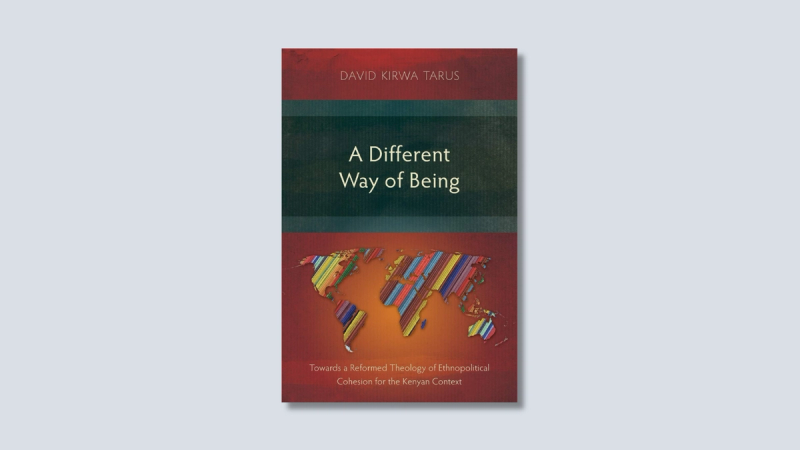
A Different Way of Being: Towards a Reformed Theology of Ethnopolitical Cohesion for the Kenyan Context
By David Kirwa Tarus
Langham Monographs | 2019 | 230 pages (paperback) | $40.99
I have had the pleasure of corresponding with David Kirwa Tarus while writing my children’s book on Byang Kato (an important African theologian). I have a high estimation of Tarus’s work in his African context, and I am a firm believer in the importance of learning from the global church because we can often get used to our comfortable blinders. I was eager to read this book, certain that it would have much to offer to churches outside of its geographical area. I was not disappointed.
Tarus begins by agreeing with a Facebook user that most Kenyan Christians pledge their allegiance first to their tribe, then to their political parties, and finally to Christ. Although this book was written to address the problem of ethnopolitical conflicts in Kenya, it made me wonder if, by substituting the word “tribe” with “family,” this assessment could be applied to some American Christians.
This misguided allegiance, Tarus argues, is at the root of the animosity, bigotry, and violence that have plagued his nation. The numbers are staggering. In the months following the disputed presidential election of Mwai Kibaki on December 27, 2007, more than 1,100 Kenyans were reported killed, thousands more injured, 650,000 people internally displaced and 78,000 houses were burned down. The descriptions of some of these acts of violence are disturbing.
In the face of this crisis, Tarus believes that “the search for ethnic cohesion in Kenya is a theological task that calls for a new theological anthropology and politics. Thus, a new future in Kenya calls for a new way of being human, which can only be availed of when people respond to the divine call and grace” (2).
The book goes on to consider how this goal can be achieved. What Tarus calls “a new theological anthropology” is essentially a return to the biblical teaching that humans are created in God’s image. Tarus devotes a whole chapter to this concept of the imago Dei as a reality that encompasses all humanity, though marred by the Fall. To this, Tarus adds a reminder that this image includes people of all ethnicities—a reality which he believes to be prelapsarian, given that “God’s creation is depicted as an intricate world of vibrant diversity” (6). (He follows this statement with biblical references.)
In the same chapter, Tarus examines several views of the imago Dei throughout church history and particularly in the writings of John Calvin. Drawing from the works of several authors, Tarus highlights ways in which a diminished view of God's image in mankind can lead to violence. Conversely, he shows how a true understanding of God's image, exemplified in the courageous actions of Kenyan Christians in the wake of the 2007–2008 violence, is foundational to the Kenyan value of utu (human dignity). This might be his most important chapter in the book, since the imprint of God's image on every human being is at the foundation of Tarus's challenge to the church.
The following chapter explores the meaning of identity for a Christian, showing how the Christian maintains his or her identity while forgoing aspects of that identity “that are not aligned with God’s will” (134). This chapter underlines the roles of Christ, the Holy Spirit, God’s word, and the church, as well as the progressive nature of sanctification.
Chapter six deals with the issue of politics. I have some qualms about the comparison of David VanDrunen’s thought with that of Neo-Calvinists such as Abraham Kuyper, since the use of terms such as “dualism,” “dichotomy,” and “antithetical” to describe VanDrunen’s view of God’s two kingdoms is not accurate. VanDrunen’s writings clearly outline that both kingdoms are God’s and are therefore complementary, although distinct. The chapter as a whole, however, is an excellent reflection on a Christian view of politics in light of Calvin's perception of it as an instrument for the common good, which includes the interests of the poor and marginalized.
The last three chapters in the book address the thought and work of four significant Kenyan theologians: David Gitari, Henry Okullu, Jesse Mugambi, and John Mbiti. Each of these men proposed different solutions to Kenya’s problems. After giving a brief description of their lives, Tarus examines their views in comparison with Calvin’s.
Throughout the book, Tarus quotes many other authors, including members of the Circle of Concerned African Women, a group that has made important contributions to African theology. Some Western Christians might react negatively to definitions such as “feminist” or “liberation theology,” but the meaning intended by the authors might differ from our assumptions. For example, Mercy Amba Oduyoye, founder of the Circle, defines feminist theology as “simply letting African women solve issues African women encounter in their day-to-day lives” (18).
History enthusiasts will enjoy the chapters devoted to the history of postcolonial Kenya, which highlights some problems of colonialism which are not typically discussed in history books. According to Tarus, even most missionaries unwillingly “precipitated the volatile problem of tribalism in Kenya by concentrating their outreach on specific ethnic communities while neglecting others” (94).
The book concludes with a challenge to Kenyan Christians not only to put into practice the doctrine of the imago Dei, but also to learn to converse charitably with others in their pluralistic society: “Kenyan Christians, as they respond to God’s gift of grace in their lives, are enabled to live lives that truly reflect the meaning of love and neighborliness in a society that is characterized by ethnic hatred and political divisions” (292).
While Tarus embraces a view of faith as integrated into all aspects of life, he strongly cautions against coercion and exhorts Christians to “be civil in their engagement with culture,” seeking language that emphasizes common ground (293).
This book may not appeal to everyone. Those readers with many daily responsibilities may not have time to study the history and challenges of the church in Kenya alongside proposed theological solutions. But for readers concerned about rising violence and division in our own country, listening to voices from contexts that have endured similar struggles—often on a greater scale—might prove beneficial and enriching.